BC548 Transistor: Pinout, Datasheet, and Equivalents
The BC548 is a general-purpose NPN bipolar junction transistor (BJT) widely used in low-voltage electronics. It is the 30V sibling to the popular BC547, making it ideal for standard 5V, 9V, and 12V circuits where high voltage handling is not required. This guide covers the pinout configuration, technical specifications, and how it compares to the BC547.
BC548 Pinout Diagram
The BC548 uses the industry-standard TO-92 package. The pin configuration is identical to the BC547 series.
BC548 Pinout: NPN BJT transistor, TO-92 package, 3-pin through-hole mount
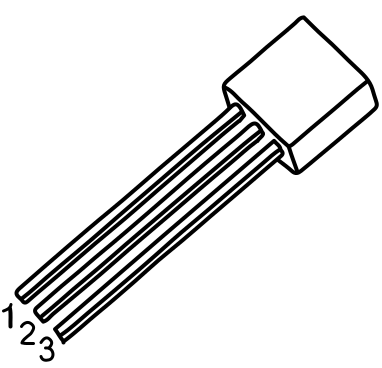
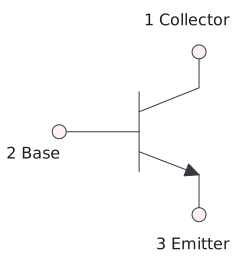
| Pin No | Pin Name | Function |
|---|---|---|
| 1 | Collector (C) | Current In |
| 2 | Base (B) | Control / Bias |
| 3 | Emitter (E) | Current Out (Ground) |
BC548 Datasheet and Technical Specifications
Key electrical characteristics and maximum ratings for the BC548 transistor at 25°C ambient temperature.
View BC548 Datasheet (PDF)| Parameter | Value | Description |
|---|---|---|
| VCEO | 30V | Max Collector-Emitter Voltage |
| VCBO | 30V | Max Collector-Base Voltage |
| VEBO | 5V | Max Emitter-Base Voltage |
| IC | 100mA | Max Collector Current |
| Pd | 625mW | Max Power Dissipation |
| hFE | 110-800 | DC Current Gain (varies by variant) |
| fT | 150MHz | Transition Frequency (Min) |
| VCE(sat) | 250mV | Saturation Voltage |
| Temp Range | -55°C to +150°C | Operating Temperature |
Primary Usage: The BC548 is strictly for low-voltage applications (under 30V). For circuits operating near or above 30V, use the BC547 instead.
BC548 Equivalent and Replacement Transistors
The following NPN transistors share the TO-92 package and have similar or better voltage/current ratings, making them suitable replacements.
| Part Number | Manufacturer | VCEO | IC | hFE |
|---|---|---|---|---|
| 2N3904BU | onsemi | 40V | 200mA | 100 |
| 2SD1616A(RANGE:200-400) | JSCJ | 60V | 1A | 200 |
| ZTX455 | DIODES | 140V | 1A | 100 |
| ZTX694B | DIODES | 120V | 500mA | 400 |
| ZTX450 | DIODES | 45V | 1A | 100 |
| 2N4401BU-HXY | HXY MOSFET | 40V | 600mA | 300 |
| KTC3202-Y-HXY | HXY MOSFET | 40V | 600mA | 300 |
| KSP8099TF-HXY | HXY MOSFET | 160V | 600mA | 200 |
BC548 Variants: A, B, and C
Like the BC547, the BC548 is manufactured in three gain groups. The letter suffix determines the DC Current Gain (hFE) range.
| Variant | hFE Range | Usage Case |
|---|---|---|
| BC548A | 110 - 220 | General Switching |
| BC548B | 200 - 450 | Signal Amplification (Most Common) |
| BC548C | 420 - 800 | High Gain Pre-Amplifiers |
If you're looking for the BC548CTA transistor produced by onsemi, please check out its datasheet and specifications here.
BC548 vs BC547: What's the Difference?
These two transistors are physically identical and often confused. The only difference is the breakdown voltage.
| Specification | BC548 | BC547 |
|---|---|---|
| Max Voltage (VCEO) | 30V | 45V |
| Max Current (IC) | 100mA | 100mA |
| Application | 5V, 9V, 12V Circuits | Up to 24V/36V Circuits |
Summary: You can always use a BC547 to replace a BC548. However, you should not use a BC548 to replace a BC547 if the circuit voltage exceeds 30V.
Common BC548 Applications
Due to its low cost and availability, the BC548 is used in basic educational and consumer electronics:
- Relay Drivers: Switching small 5V/12V relays.
- Sensor Circuits: Amplifying signals from LDRs or thermistors.
- Audio Preamps: The 'B' and 'C' variants are excellent for microphone pre-amplifiers.
- Logic Gates: Building basic NOT/AND gates in educational labs.
Frequently Asked Questions
Related Transistor Guides
Explore more transistor pinout and datasheet guides for popular components: